Why metal filter elements are the safer choice in high-temperature, high-pressure processes
Why metal filter elements are the safer choice in high-temperature, high-pressure processes
In the real world, industrial processes are rarely gentle. Temperatures climb and remain elevated. Pressures fluctuate unpredictably, rising, dropping, and surging again. Liquids and gases can carry abrasive particles, sticky residues, and aggressive chemicals, all of which place continuous demands on process equipment. In environments such as these, filtration and separation are not simply about meeting specification requirements; they are critical to maintaining safe, reliable, and efficient operation.
This is where metallic filter elements offer a significant advantage. At CFL, we spend a lot of time talking to engineers and plant managers who have learned, often through costly experience, that not all filtration and separation solutions are created equal. Under demanding operating conditions, metallic filters quickly stop being viewed as a premium option and instead becomes the practical and dependable option.
When standard filters start to fall short
Many systems begin with polymer or fibre based filters. Under lower temperatures and stable operating conditions, these solutions can perform perfectly adequately. The challenge begins when elevated temperatures and fluctuating pressures become part of normal operation rather than occasional process events.
High temperatures can gradually compromise non metallic filter media. Polymers may soften, deform, or lose dimensional stability, while fibre based materials can weaken and lose structural integrity over time. In many cases, a filter may still appear physically intact whilst its filtration performance has already deteriorated. Even subtle changes in pore structure can reduce efficiency and allow contaminants to bypass the filtration barrier.
Pressure introduces an additional level of stress. As differential pressure increases, weaker media can compress, deform, or collapse entirely. In the most severe cases, sudden filter failure can occur, allowing debris to pass directly into downstream equipment and the wider process. The result is often unplanned downtime, process disruption, and expensive maintenance intervention — rarely at a convenient time.
Designed to stay stable under pressure
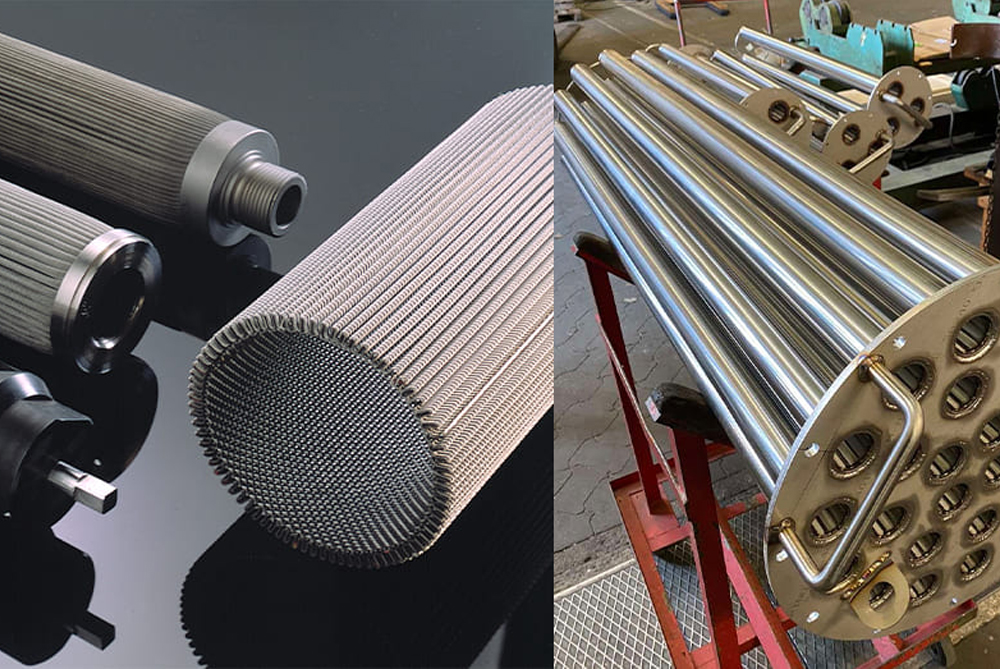
Metallic filter elements are specifically engineered for operating environments where process conditions leave little margin for error. Manufactured from materials such as stainless steel and specialist alloys, they retain their strength and dimensional stability at temperatures that would rapidly degrade many alternative filter media’s.
Unlike non-metallic materials, heat does not cause metal filters to soften, deform, or lose their internal pore structure. Filtration and separation performance therefore remains consistent over time, rather than gradually drifting as operating conditions intensify. In continuous industrial processes, this stability is critical. Even minor changes in filtration efficiency can influence product quality, reduce process reliability, or place additional strain on downstream equipment.
Resistance to pressure is another major advantage. Metallic filter elements are designed to withstand high differential pressures and repeated pressure fluctuations without compromising structural integrity. Where pressure cycling is a normal part of operation, this durability helps prevent minor process disturbances from developing into larger operational failures.
Coping with constant heating and cooling
Industrial systems rarely operate at a single, stable temperature. Start-ups, shutdowns, cleaning cycles, and routine maintenance all introduce repeated heating and cooling phases. Over time, this thermal cycling places significant mechanical and structural stress on filtration components.
Non-metallic filter elements can begin to show fatigue under these conditions. Delamination, seal degradation, and gradual loss of performance are all common failure modes. In many cases, these issues develop slowly and remain hidden until a sudden or unexpected failure occurs.
Metallic filter elements are far more resilient in these environments. They are designed to accommodate thermal expansion and contraction without loss of structural integrity or filtration performance. In batch processes or applications with frequent temperature variation, this stability helps maintain consistent uptime and reduces the risk of unplanned interruptions.
Filters that can be regenerated, not constantly replaced
Metallic filters are sometimes perceived as robust but relatively simple components. In reality, modern designs deliver a high level of filtration and separation precision alongside their mechanical strength.
Sintered metal filter elements are manufactured by fusing metal particles, meshes and fibres into a single, solid structure. This creates a durable filtration and separation medium with a controlled and consistent pore network that performs reliably over extended service periods.
Because the structure is fully thermally bonded, there are no loose fibres or migrating media that can enter the process stream. This eliminates the risk of media shedding or contamination, which is particularly important in applications where product purity is critical. As a result, sintered metal filters are widely used in pharmaceutical production, specialist chemical processing, and other high purity industrial applications.
Standing up to aggressive process conditions
Heat and pressure often draw the most attention, but they are not the only factors that challenge filtration and separation performance. Corrosive liquids, reactive gases, and abrasive particles can be equally demanding on filtration and separation systems. This is why material selection is so critical to reliable operation.
No two processes place identical demands on filtration and separation equipment. Metal filter elements can be manufactured in a range of alloys, enabling them to be matched to both moderate operating environments and far more aggressive chemical conditions. Selecting the correct material ensures the filter continues to perform consistently throughout its service life.
Getting that selection right protects more than just the filter element itself. Reduced corrosion and improved mechanical integrity help minimise the risk of leaks, blockages, and unplanned downtime, while also supporting safer and more stable overall system operation.
Consistency that supports better process control
When a process is operating under elevated temperature or pressure, predictability becomes essential. Any variation in filtration or separation performance can quickly translate into off-spec product, increased equipment wear, or potential compliance challenges.
Metallic filter elements are designed to deliver consistent performance over extended service periods. Their solid construction and stable pore structure ensure that filtration and separation characteristics remain unchanged during operation, even under demanding conditions.
For engineers, this level of stability removes much of the uncertainty from process control. With fewer variables introduced by the filtration stage, systems can be run with greater confidence, supporting improved process efficiency and more reliable output quality.
Making the right choice for the long term
While metallic filter elements are well suited to demanding operating conditions, correct specification remains essential. Every parameter must be considered, from operating temperature and pressure, through to flow rates, particle size distribution, and chemical compatibility.
Engaging with a filtration and separation specialist helps ensure these factors are correctly evaluated at the design stage. A well engineered metallic filtration solution does more than withstand harsh conditions; it enhances process reliability, reduces maintenance requirements, and supports stable long term performance across the system.
Built for reality, not ideal conditions
Industrial processes rarely operate under controlled or idealised conditions. Elevated temperatures, fluctuating pressures, chemical exposure, and continuous operational change all combine to place significant demands on filtration and separation systems.
Metallic filter elements are designed to perform reliably in exactly these environments. They deliver mechanical strength without compromising precision, maintain structural integrity under challenging conditions, and provide consistent filtration and separation performance where other solutions can struggle to remain stable.
For real world processes, this combination of durability and consistency is critical. It ensures filtration and separation does not become a weak point in the system, but instead contributes to overall process stability, efficiency, and reliability.
Where heat, pressure, or aggressive operating conditions are a factor, a brief technical discussion can help establish whether the current filtration and separation approach is truly optimised for long-term performance.
Speak with the CFL team to review your application and assess whether a metallic filtration and separation solution could offer a more robust and reliable alternative.
Latest News

Filtration Efficiency and ROI: The Hidden Costs of Poor Separation Performance
How High Integrity Manufacturing Supports Nuclear Filtration and Separation Performance

Why specialist field services are key to filtration performance
Why Differential Pressure in Filtration and Separation Applications Is More Important Than You Realise
Why metal filter elements are the safer choice in high-temperature, high-pressure processes





No comments yet.